
An actor's voice is so much more than just the sound they use to deliver lines. It's the instrument that brings a character's entire inner world to life. Mastering your voice in acting is what turns a good performance into a truly memorable one, creating a connection that sticks with an audience long after the curtain falls or the credits roll.
This connection is what it's all about, whether you're on stage, in front of a camera, or behind a microphone in a voice-over booth.
What Is Voice in Acting and Why Does It Matter
Think of it this way: a violinist doesn’t just play the notes written on the page. They manipulate the pressure, speed, and angle of their bow to create feelings of joy, despair, or tension. An actor does the same with their voice. It's not just about saying the words; it's about using your voice to shape their meaning, reveal who the character is, and push the story forward.
Simply put, voice in acting is the conscious, craft-driven use of your vocal qualities to build a character. It means moving beyond your everyday speaking habits to make specific, repeatable choices that serve the performance. This is the skill that often separates a working actor from the rest.
Building Believable Characters
Your voice is the quickest way to establish a character. Think about it. A fast, high-pitched delivery might tell us someone is anxious or excited. A slow, deep, gravelly voice can suggest authority, world-weariness, or maybe just a really long day. These choices are what make a character feel like a real person.
Without this deliberate vocal work, there's a real danger that every character you play will sound exactly like you. Developing vocal flexibility allows you to create distinct, authentic personas that stand out in auditions and stick in the minds of the audience.
Your voice is your audible identity. For an actor, it’s a flexible costume worn to instantly communicate who the character is, where they come from, and what they feel, often before a single word of dialogue is fully understood.
Creating an Emotional Connection
Beyond just building a personality, your voice is a direct channel to your audience's emotions. A tiny, almost imperceptible crack in the voice can convey more heartbreak than an entire monologue. A warm, resonant tone can create an instant sense of trust, which is absolutely crucial for commercials and corporate narration work.
This emotional link is everything. A performance can be technically perfect, but if it lacks genuine feeling in the voice, it will leave an audience cold. The ability to make a listener feel something is a critical skill for any actor in the Australian market and beyond. It’s how you get an audience to do more than just listen—you make them care.
The Core Components of a Powerful Acting Voice
To get real control over your voice, you have to know what it’s made of. Just like a musician needs to master their scales before they can play a symphony, an actor has to get a handle on the individual parts of their voice to build a believable character.
These elements are the building blocks of a truly powerful voice in acting. Moving past just delivering lines instinctively and into the realm of conscious, skilful artistry means understanding five key pillars. They give you the vocabulary and the tools to break down a script, shape your performance, and make sure every word you speak has purpose.
Pitch and Tone
First up, let's separate Pitch and Tone. Pitch is simply how high or low your voice is. Tone, on the other hand, is the emotional colour you paint over your words. They’re a team, but they do different jobs.
Think of it this way: pitch is the specific note on a piano, while tone is how you play it—gently, aggressively, sadly. A character might have a naturally low pitch to signal authority, but their tone could shift from warm and reassuring in one moment to cold and menacing the next, all without the pitch changing. Getting a grip on tone is how you inject subtext and emotional depth into every line. To really expand your emotional palette, many actors find it useful to do creative thinking exercises to get their imagination firing.
Pace and Volume
The Pace of your speech is the heartbeat of the scene. Speaking quickly can build excitement or a sense of panic, while a slow, measured pace can crank up the tension, show someone is deep in thought, or signal complete exhaustion. It’s one of the most direct ways to control a scene’s energy.
Volume, or how loud or soft you are, is all about intent. A sudden shout can convey shock or fury, but a whisper can pull the audience in, creating a moment of pure intimacy or revealing a dark secret. A performance that never changes volume feels robotic and flat; dynamic range is everything.
A classic rookie mistake is playing just one note. An angry character doesn't just yell. Their frustration might cause them to speed up their speech, or they might drop their volume to a threatening whisper. It's the interplay between all these vocal tools that creates a performance people can actually connect with.
Timbre: The Vocal Fingerprint
Finally, there’s timbre (pronounced tam-ber). This is the unique, natural quality of your voice—it's your vocal signature. It’s what makes your voice different from everyone else’s. Words we use to describe it include ‘raspy’, ‘breathy’, ‘smooth’, or ‘resonant’.
While you can’t completely change your base timbre, you can absolutely learn to modify and colour it. You could add a bit of gravel to your voice for a world-weary detective or a breathy quality for a character who is naive or innocent. The first step is to understand your own natural timbre; learning how to manipulate it is where the real artistry begins. For anyone looking to seriously hone these skills, exploring professional voice training online can offer the structured guidance and exercises needed to take your performance to the next level.
https://thevoiceoverguy.com.au/voice-training-online
To help you put it all together, here’s a quick summary of how these components function as your performance toolkit.
The Five Pillars of Vocal Performance
| Component | What It Controls | Practical Tip |
|---|---|---|
| Pitch | The highness or lowness of the voice. | Record yourself reading a paragraph at your highest, lowest, and middle pitch to understand your range. |
| Tone | The emotional quality or feeling behind the words. | Try saying "I'm fine" to convey happiness, anger, sadness, and sarcasm. Notice how the meaning changes. |
| Pace | The speed of speech. | Read a fast-paced action scene slowly, and a slow, thoughtful monologue quickly. Feel how it changes the energy. |
| Volume | The loudness or softness of the voice. | Practise whispering a line so it's still clear, then delivering the same line as a shout without straining. |
| Timbre | The unique texture or quality of the voice. | Experiment by adding different qualities like breathiness, rasp, or nasality to a neutral sentence. |
Learning to identify and control each of these five pillars is what allows you to build a character from the ground up, ensuring every single word serves the story and lands with impact.
How Voice Acting Differs from Stage and Screen
While they all fall under the banner of acting, the craft of performing for the stage or screen is a world away from working in a recording booth. On stage, your entire body is an instrument. Your posture, a subtle gesture, a raised eyebrow—it all works together to tell the story. You have a massive canvas to paint your character on.
But in voice acting? That entire canvas shrinks down to one single, powerful tool: your voice. Every bit of emotion, every character trait, and every physical nuance has to be channelled purely through sound. This isn't just a slight adjustment; it’s a completely different discipline.
A stage actor is like a full orchestra, with every section contributing to the performance. A voice actor, on the other hand, is a solo concert pianist. Every note must be deliberate, perfectly weighted, and timed with precision to convey the entire emotional landscape of the piece.
The Microphone Is Your Audience
Stage actors learn to project, to fill a cavernous theatre and reach the people in the back row. For a voice actor, the entire audience is a hyper-sensitive microphone sitting just a few inches from their face. This proximity changes everything.
Instead of throwing your voice outwards, you learn to draw the performance inwards, creating an intimate and detailed experience. The microphone picks up everything. A tiny sigh, a slight waver in your voice, a quiet shift in tone—these become your most powerful storytelling tools. It demands incredible vocal control and a deep, intuitive feel for microphone technique.
In the booth, the microphone isn't just a piece of tech; it becomes your scene partner. It hears your true intention and every layer of subtext you bring to the read. Learning to work with the mic, not just talk at it, is what separates the pros from the amateurs.
Technical Precision and Consistency
Beyond the performance, voice acting brings a whole new layer of technical challenges that simply don't exist in live theatre. A professional voice actor must master the ability to:
- Maintain Vocal Consistency: When recording a long-form project like an audiobook or an e-learning series, you have to sound exactly the same from one session to the next, even if they're weeks apart. That means matching the character’s voice, pitch, and energy perfectly every time.
- Eliminate Extraneous Noise: The slightest mouth click, a pop, or even the sound of your clothes rustling can compromise a take. You learn to control your physical presence to deliver a crystal-clear recording.
- Manage Plosives and Sibilance: Those hard 'p' and 'b' sounds (plosives) or sharp 's' sounds (sibilance) can cause distortion in a recording. A key skill is learning to manage these sounds without losing the performance's energy.
Since voice acting is all about the recording, knowing how to get the best out of your setup is non-negotiable. You can find plenty of great Voice Recording Tips online that can help you sharpen your technical skills.
This is the craft that ensures clients get broadcast-ready audio without needing hours of clean-up in post-production. You can dive deeper into this by reading about the art of the voice over on our blog. It’s what makes every recording clean, clear, and truly impactful.
Applying Vocal Skills in Australian Media
It’s one thing to understand the theory behind a powerful acting voice, but seeing it work in the real world is where it all clicks. Across the Australian media landscape, a professional voice actor’s skills are stretched in wildly different directions, from the upbeat energy of a retail ad to the reassuring, steady tone needed for corporate narration.
An actor might find themselves recording a clear, authoritative e-learning module on Monday, then jumping into a recording booth on Tuesday to create a zany, high-pitched character for a new animated series. Every single job requires a completely different use of pitch, pace, and tone to hit the mark with a specific audience. And with digital media growing so quickly, the need for this kind of vocal gymnastics has never been greater.
This infographic breaks down the core differences between performing live on stage and working purely with your voice in a studio.
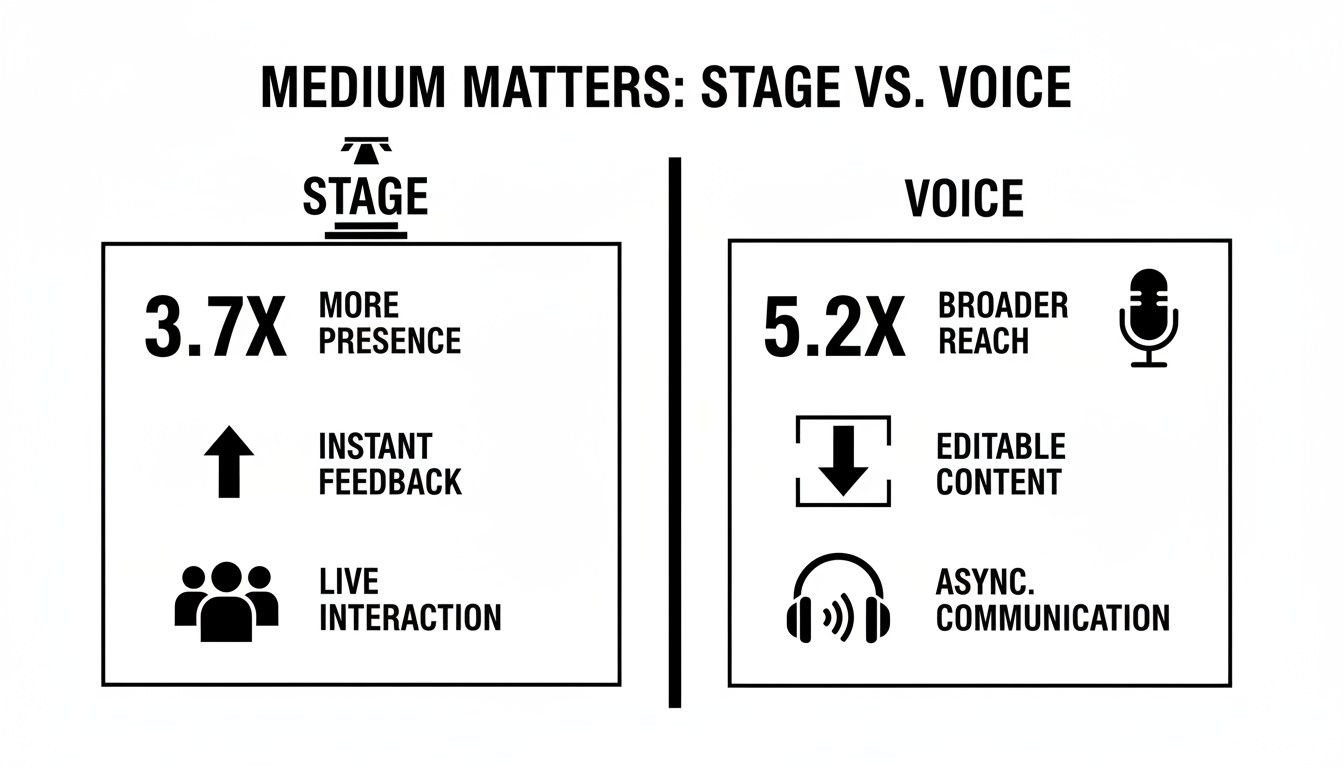
As you can see, the voice in acting becomes the only tool in a voice-over session. The actor has to channel every bit of emotion, context, and meaning through sound alone.
Commercials and Narration
When it comes to commercials, the voice literally becomes the sound of the brand. Think about a classic ‘hard-sell’ retail ad – it needs buckets of energy, an urgent pace, and a persuasive tone that gets people moving. Now, picture an ad for a bank or an insurance company. The goal there is completely different; it calls for a calm, steady, and resonant voice to build a foundation of trust and reliability.
Corporate narration is another field where vocal precision is paramount. Whether for internal training videos or client-facing presentations, the objective is to be clear and engaging. The voice has to hold the listener’s attention without becoming a distraction itself. This usually means adopting a neutral, professional tone with deliberate pacing and crisp enunciation, making sure every single word lands perfectly. For businesses looking to produce radio spots, we have a detailed guide on how to advertise on radio effectively.
The Digital Content Boom
The explosion of digital content has opened up a massive new playground for voice actors in Australia. This is especially true on platforms like YouTube and TikTok, where local brands are constantly creating content to connect with huge audiences. The numbers are staggering. According to late 2025 data, YouTube’s advertising managed to reach 21.0 million users in Australia, which is a whopping 77.7% of the entire population. Over on TikTok, the ad reach jumped by 1.33 million users in just one year, proving how much brands are investing in short-form video. You can dive deeper into these Australian digital trends on DataReportal.
This digital shift means opportunities are everywhere. An engaging voice in acting is no longer a nice-to-have; it's a vital part of everything from punchy social media ads to long-form explainer videos and branded podcasts that tell a deeper story.
This online expansion demands actors who can mould their performance to the format. A 15-second TikTok video needs a voice that can hook someone instantly. A 10-minute YouTube explainer, on the other hand, requires a voice that can sustain interest and make complex information easy to digest. For Australian businesses, investing in a professional voice is no longer a luxury—it’s a crucial step in making sure their brand is actually heard in a very crowded online world.
How to Direct and Cast the Perfect Voice for Your Project
Finding the right voice for your project isn't just about picking someone who sounds nice. It's about finding a performer who can get to the heart of your message and forge a genuine connection with your listeners. This whole process actually begins long before you hit 'play' on the first audition file.
The single most important thing you can do is write a crystal-clear casting brief. So often, briefs are filled with vague words like ‘energetic’ or ‘professional’, but these mean different things to different people and usually result in a pile of auditions that miss the mark. You need to focus on the feeling you want your audience to walk away with.
Creating a Powerful Casting Brief
Instead of asking for an 'upbeat' voice, paint a picture for the actor. Try something like, "We need a voice that sounds like a trusted friend sharing exciting news over a coffee." Now that gives the actor a tangible scenario to perform and an emotional target to aim for. That context is pure gold.
A truly effective brief will always spell out these key details:
- Target Audience: Who are you actually talking to? The voice that resonates with millennial tech founders is going to be wildly different from one aimed at retired homeowners.
- Project Context: Is this a slick, fast-paced retail ad, a heartfelt charity appeal, or a dry e-learning module on compliance? The purpose shapes the entire delivery.
- Desired Emotional Response: What do you want your audience to feel? Inspired? Reassured? A sense of urgency? Maybe just plain curious?
Getting this specific helps you move past simple imitation and empowers an actor to deliver a real, nuanced performance. You'll get much more authentic and memorable results if you resist the temptation to ask for a "sound-alike" of a famous celebrity. If you're a bit stuck on where to begin, our guide on choosing the right voice for your brand can be a huge help.
The Value of Authentic Talent
More and more, casting decisions around the world are being driven by a need for authentic, human connection. A recent industry study from Gravy For The Brain on future voice acting trends found a major swing towards localisation, with 58% of voice-over buyers planning to work with non-English speaking talent. This push for cultural nuance shows a growing realisation that audiences connect best with voices that just get the local slang, humour, and rhythm of speech.
Casting a professional, native-speaking actor isn't a cost; it's a strategic investment in your brand's authenticity. An experienced actor brings an intuitive understanding of subtext and emotion that synthetic voices simply cannot replicate, ensuring your message lands with real impact.
For businesses here in Australia, this means putting a premium on local talent. You want someone who can deliver a performance that feels completely natural and familiar to an Aussie audience. Whether it's for a national ad campaign, an animated series, or a simple online video, a professional voice in acting turns your project from just another piece of content into a compelling experience that builds real trust.
Frequently Asked Questions About Voice in Acting
Whether you're an actor sharpening your craft or a client trying to cast the right voice, you're bound to have questions. Getting to grips with the finer points of vocal performance is what separates a good project from a truly great one. Let's tackle some of the most common queries we hear from both sides of the microphone.
How Can I Improve My Vocal Range for Acting?
Expanding your vocal range is a marathon, not a sprint. It’s all about consistent, healthy technique, not pushing your voice where it doesn’t want to go. The best place to start is with gentle warm-ups before any practice. Think humming, lip trills (that motorboat sound), and slow, easy "sirens" where you slide from a low to a high note and back on a soft 'oo' vowel.
These exercises gently prepare your vocal folds for work without causing any strain. Of course, nothing beats working with a vocal coach who can give you specific exercises to safely build your range and resonance. But remember, consistency is king—a focused 10-15 minutes of practice each day will do far more for you than a single, hour-long session once a week.
What Is the Difference Between Timbre and Tone?
This is a brilliant question because it cuts right to the heart of vocal control. It’s easy to mix them up, so let's use an analogy.
Timbre is your voice's unique fingerprint. It's the inherent quality, texture, and character that makes your voice yours. It's why a friend can recognise you instantly over the phone. Words like 'raspy,' 'breathy,' 'rich,' or 'nasal' are all describing a voice's natural timbre.
Tone is the emotional colour you paint over your words. It’s the attitude behind your delivery. While your timbre stays relatively constant, your tone can flip from excited to devastated to sarcastic, all in one sentence.
An actor uses their unique timbre to stand out, but they master tone to tell the story.
Your timbre is the instrument, but your tone is the music you choose to play. An actor's job is to master the music, using tone to tell the story happening beneath the dialogue.
Why Should I Hire a Professional Actor Instead of Using AI?
It’s true that AI voice technology has come a long way, but it's still just mimicking sound. It fundamentally lacks a human's lived experience, which is the source of all genuine emotion, context, and subtext. A professional actor doesn't just read lines; they interpret the script, feel the intention, and make thousands of tiny, intuitive adjustments to forge a real connection with the listener. That human touch is everything when it comes to building brand trust.
For businesses here in Australia, hiring a local professional brings another massive advantage: cultural fluency. An Aussie actor just gets the local humour, the turn of phrase, and the delivery styles that land perfectly with an Australian audience. That's a level of nuance that AI simply can't fake.
What Are the Most Important Vocal Health Tips for Actors?
Your voice is your most valuable professional tool, so looking after it is non-negotiable. The single most important habit you can build is hydration. Sipping water all day long keeps your vocal folds lubricated and working smoothly.
Beyond that, always warm up before a recording session and cool down afterwards with some gentle humming. Try to avoid shouting or whispering for extended periods, as both put a surprising amount of strain on your voice. Lastly, get a good night's sleep and be mindful of things that dehydrate you, like alcohol and caffeine. If you ever feel ongoing hoarseness or pain, don't wait—see a medical professional.
Ready to find the perfect, authentic Australian voice for your next project? At The Voice Over Guy, we make it simple to get broadcast-ready audio fast. Browse our talent and get an instant quote today!