
That awkward silence. That repetitive, tinny music. It’s not just a minor annoyance for your callers—it’s a silent business killer. A well-thought-out on hold message strategy transforms that dead air from a liability into one of your most effective marketing assets. It’s about more than just filling the silence; it’s about preventing caller frustration and protecting your revenue.
The Hidden Cost of a Bad On Hold Experience

Most business owners see hold time as a necessary evil. But think about it from the customer's perspective. Leaving them in total silence or forcing them to listen to grating elevator music sends a pretty clear message: their time isn't important to you. It's a small detail, but it has a surprisingly large financial impact, often sending would-be customers straight to your competitors.
That "dead air" creates a poor first impression. Someone calling for help or to make a purchase is already in a state of anticipation. Meeting them with nothing but silence breeds anxiety. Did the call drop? Is anyone ever going to pick up? It’s not a great start.
The Real Numbers Behind Caller Frustration and Lost Sales
The damage from a bad on-hold experience isn't just a theory; it’s a quantifiable problem. The data paints a stark picture of just how much a poor waiting experience can hurt a business in Australia.
How a Bad On Hold Experience Impacts Your Business
| Statistic | Impact on Your Business |
|---|---|
| 8 in 10 Aussies (80%) admit they would switch to a competitor after a poor customer service wait. | A significant portion of your customer base is at risk of leaving due to frustration, directly impacting your market share. |
| The average Australian spent 11.1 hours on hold last year. | Callers are already sensitive to waiting. An unengaging hold experience amplifies their impatience and negative perception of your brand. |
| A collective 123 million hours were wasted by Australians on hold annually. | This widespread issue means customers are less tolerant than ever. A professional on-hold message can set you apart from competitors who ignore this problem. |
These figures, detailed in a comprehensive ServiceNow report, show that frustration quickly turns into lost revenue. Every caller who hangs up is a lost sale, a missed service opportunity, and a damaged relationship. You don’t just lose one transaction; you risk losing the entire lifetime value of that customer.
A poorly managed hold queue is a leaky bucket for your business. For every moment a customer waits in silence, your brand's credibility and their patience drip away.
Turning Wasted Time into a Marketing Win
The great news is that hold time doesn't have to be a negative. With a bit of strategic thinking, you can reframe this waiting period as a captive marketing channel. Professional on hold messages are the key to turning a frustrating wait into a positive brand interaction.
Instead of tuning out, your callers could be learning about:
- A new service or a special promotion they weren’t aware of.
- Answers to common questions, which can ease their frustration and even reduce your team's workload.
- Your website address or social media channels, encouraging them to connect with you elsewhere.
- Brand-building stories that share what makes your business different and worth waiting for.
By giving them something valuable to listen to, you make the wait feel shorter and reinforce their decision to call you in the first place. A polished, informative message signals professionalism and a genuine commitment to customer care, ultimately protecting your bottom line and building loyalty.
How to Plan Your On Hold Message Content
Great on hold messages are no accident—they’re born from a solid plan. Before you even think about writing a script, you need to know exactly what you want to achieve. Ditching the generic "thanks for your patience" is your first move. This is how you turn dead air into a real business asset.
Your on hold strategy needs to be woven directly into your wider business goals. Think about it: you have a captive audience on the line. What's the most valuable thing you can tell them? Your answer will shape every word of your script.
Start With One Clear Goal
The most effective on hold programs have a laser-sharp focus. Are you trying to boost sales, make customer service smoother, or simply build up your brand's image? Pick one main goal and build your content around it.
For instance, a retail store in Brisbane could use its hold time to hype up an upcoming seasonal sale. A busy IT support company in Melbourne, on the other hand, might use its messages to walk through solutions for common problems, potentially solving a caller's issue before they even speak to a person.
Your on hold message is a direct line to your customers when they are most engaged. Don't waste it. Decide if you want to inform, sell, or assist, and build every message around that singular purpose.
Having a clear objective makes your content instantly more relevant and ensures you see a real return. Suddenly, your phone system isn't just a utility; it's an active marketing and service tool.
Think About Who’s Calling
Not all callers are created equal. Someone ringing your sales line for the first time has completely different needs from a long-time client calling for tech support. By creating different messages for different phone lines or departments, you make the experience far more personal and effective.
For your sales line, you could craft messages that:
- Highlight what makes your business stand out from the competition.
- Guide callers to a specific webpage with compelling case studies or reviews.
- Announce a special, limited-time offer just for new customers.
Meanwhile, your customer support line is better off focusing on practical help. Your messages could:
- Provide answers to the top 3-5 most common support questions.
- Remind callers of your business hours or service level agreements (SLAs).
- Point them toward self-service options like your online knowledge base or FAQ page.
This targeted approach shows you're paying attention to your caller's needs and that you respect their time. If you want to explore how this connects with automated menus, you can find more insights on using a professional IVR and messages on hold recording.
What Should You Actually Talk About?
Once you’ve locked in your goal and your audience, it’s time to brainstorm the actual content. A good on hold program should feel dynamic, mixing different kinds of information to keep callers engaged.
Here are a few proven ideas to get the ball rolling:
- Marketing & Promos: This is your chance to announce new products, talk about special offers, or mention an upcoming event. It's a prime spot for a bit of upselling or cross-selling.
- Genuinely Helpful Info: Share your business hours, street address, or easy-to-follow directions. This basic info can cut down on the questions your team has to answer.
- Your Digital Footprint: Give out your website URL, mention your LinkedIn or Facebook page, or highlight a recent blog post you’re proud of.
- Brand Stories: Tell a short story about your company. Maybe it’s about your history, your work in the local community, or a recent award you’ve won.
- FAQs: Answering common questions directly in the hold message educates your callers and frees up your staff to tackle more complex issues.
By mixing and matching these elements, you create a varied and valuable listening experience that makes the wait feel shorter and more worthwhile for everyone.
Scripting Messages That Keep Callers Listening
Now for the fun part: writing the actual messages. With your strategy locked in, it's time to put pen to paper (or fingers to keyboard) and create the content that will bring your on-hold experience to life.
The goal here is simple: write messages that sound genuinely helpful and human, not like a pushy, robotic sales pitch. This is your moment to forge a real connection, one short message at a time.
The most common trap I see businesses fall into is writing scripts that are way too long, overly formal, or stuffed with industry jargon. Just remember, your caller is waiting. Every sentence needs to be short, sharp, and conversational.
Write as if you’re speaking to a single person standing right in front of you. A friendly, natural tone is always the winner.
Talk Like a Real Person
Think about how you speak in your day-to-day life. You'd never say, "We wish to inform you of our new service offering." You’d just say, "Hey, did you know we've just launched a new service?"
That small shift makes your messages instantly more relatable and much easier to listen to.
Here are a few quick tips to get that conversational style down:
- Use contractions: "you're," "we're," and "it's" sound natural.
- Ask questions: Directly engaging the listener keeps them tuned in.
- Keep sentences punchy: Get straight to the point.
- Read it aloud: If it sounds stiff or you stumble over words, it needs a rewrite.
A great script isn’t just a series of marketing messages. You need to mix it up. Alternate your promotions with helpful tips, a bit about your company's story, or even a simple "thanks for your patience".
A good rule of thumb is to aim for a 30-second message followed by 30 seconds of music. If you're not sure how many words that is, my handy guide for calculating words to minutes will help you nail the timing.
Real-World Script Examples
Let's see what this looks like for a couple of different Australian businesses.
For a Brisbane Tradie (Plumber):
"Thanks for calling Blue Wren Plumbing! While you wait, here's a quick tip: you can often prevent blocked drains by avoiding fats and oils down the sink. We’re on our way to help you shortly."
This is brilliant. It’s immediately useful and positions them as the expert, all without a hard sell.
For a Sydney Corporate Office (Financial Advisor):
"Did you know we publish a weekly market update on our blog? Visit YourFirm.com.au/blog for the latest insights. An advisor will be with you in just a moment."
This example is a smart way to drive traffic to their website and showcase their expertise. It gives the caller something valuable to do.
With the pressure on Australian contact centres higher than ever, this kind of engagement is crucial. Research from PwC Australia found a staggering 32% of customers will ditch a brand after just one bad experience. After a few bad interactions, that number skyrockets to 73%. Repetitive hold music is a major cause. Informative messages fight this trend by keeping callers engaged.
Always Have a Point
Every single message needs a purpose. A clear call-to-action (CTA) tells your caller what to do next. It gives them a clear, tangible step and makes your message stick.
And no, a CTA doesn't have to be a demanding sales command! It can be simple and direct.
Some great CTA examples include:
- "Ask our team about our end-of-financial-year special."
- "Visit our website at YourSite.com.au for more."
- "Follow us on Facebook for daily updates."
By structuring your script with this mix of helpful info, brand personality, and clear CTAs, you’ll create an on-hold experience that doesn't just keep callers on the line—it actively helps grow your business.
Getting the Sound of Your Brand Just Right
You’ve spent all this time crafting the perfect words for your on-hold message, but that's only half the battle. How those words are delivered—the voice, the tone, the music—is what truly brings your brand to life for a waiting caller. Getting this combination right is what separates a forgettable message from an experience that genuinely connects.
Think of it like casting an actor. The voice you choose is the character representing your business. A medical centre needs to project trust and compassion, so a warm, reassuring tone is a must. On the other hand, if you're a retail store hyping up a massive sale, you'll want a voice that’s energetic and upbeat. The audio becomes an instant signal of your company's personality.
How to Match the Voice to Your Brand's Vibe
Opting for a professional Australian voice actor is one of the smartest decisions you can make here. A local accent immediately builds rapport and feels more authentic to your callers. It’s a subtle touch, but it shows you're part of the local community and you understand your market.
So, what kind of voice suits you?
- Warm and Caring: This is perfect for healthcare, not-for-profits, and any business where support is central.
- Energetic and Upbeat: A great fit for retail, entertainment, or any brand wanting to create excitement around its offers.
- Professional and Authoritative: This style works wonders for legal firms, financial services, and corporate B2B companies that need to convey expertise.
Having a diverse voice library at your fingertips gives you plenty of options to find that perfect match. The goal is for the voice to feel like a natural extension of your own team. For a deeper dive, you can learn more about choosing the right voice to make sure it aligns perfectly with your brand.
Picking the Perfect Background Music
Music is all about setting the emotional stage. It’s not there to steal the spotlight from the voiceover; it’s there to complement it and fill the silence between your spoken messages. The aim is to create a pleasant atmosphere, not an annoying distraction.
While we all live on our mobiles, don't underestimate the power of a good old-fashioned phone call. Research from ACMA shows that many people, especially Gen X and Baby Boomers, still prefer to pick up the phone. And here's the kicker: great audio can make the wait feel up to 40% shorter. If your business is already creating audio for podcasts or radio ads, keeping your sound consistent is a brilliant way to reinforce your brand identity.
The biggest mistake I see businesses make is cranking the music up too loud. The voice always has to be the star. The music is there to play a supporting role, so keep it in the background where it belongs.
Try to pick a music genre that reflects your brand’s personality. A cutting-edge tech company might go for something modern and inspiring, whereas a day spa would be better served by calm, ambient tunes. Whatever you choose, make sure the volume is professionally mixed so every word comes through loud and clear. That polished finish signals quality and shows you care about the details.
Bringing Your On-Hold Audio to Life: Production and Technical Steps
You’ve got your strategy sorted and the script is polished. Now for the fun part: turning those words into a professional audio track and getting it onto your phone system. This technical stage might seem a bit daunting, but I promise it's more straightforward than it sounds when you know the steps.
First things first, you need a professional recording. This isn't just about reading a script into a decent microphone. A proper studio recording eliminates any background noise, echoes, or little imperfections that can make a message sound amateur. This is where the real magic happens and your on-hold message starts to sound truly polished.
From Raw Voice to a Polished Final Product
A raw voice recording is just the beginning. To get that broadcast-quality finish, the audio goes through a few crucial production stages. This is standard practice in professional audio and what separates a great recording from a mediocre one.
The process usually involves:
- Cleaning up the audio: All those little breaths between sentences, any slight hisses, or background hums are meticulously edited out.
- Applying Equalisation (EQ): Think of this as fine-tuning the audio frequencies. It’s how we make the voice sound crisp and clear, ensuring it sits perfectly on top of any background music.
- Mixing and Mastering: This is where the voice and music tracks are expertly blended. The goal is to make sure the voice is always clear and easy to understand, while the music sets the right mood without ever being a distraction.
We actually break down this entire process in our guide on the post-production of voice overs. It gives you a behind-the-scenes look at how we transform raw audio into something you’d be proud for your customers to hear. This level of detail is exactly why a professionally produced message sounds so much better than a quick DIY job.
This simple infographic sums up the key phases, from nailing the script to picking the perfect music.
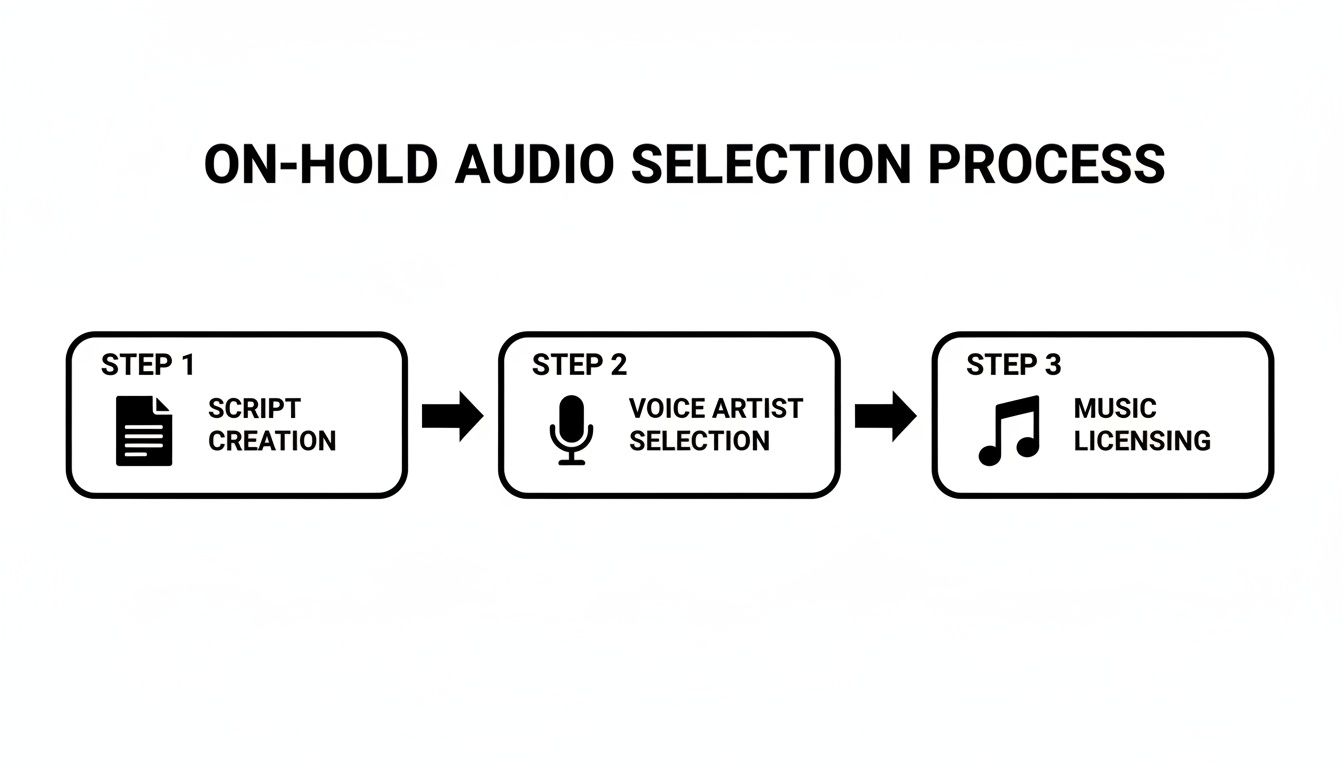
As you can see, the script, voice, and music are all distinct but interconnected parts of the journey.
Choosing the Right Audio Format
After production, you’ll receive the final audio file. But here's a crucial tip: not all audio files are created equal, and your phone system will be picky about what it accepts. The two formats you’ll encounter most often are MP3 and WAV.
- MP3: This is a compressed format, which means the files are smaller. It's the go-to for most modern VoIP (Voice over Internet Protocol) systems and is widely supported.
- WAV: This is an uncompressed format, so it delivers the highest possible audio quality. You’ll find that some older PBX (Private Branch Exchange) systems or specialised platforms might specifically require a WAV file.
My best piece of advice? Before you even think about ordering your audio, check your phone system’s manual or have a quick chat with your IT provider. Find out exactly which format and specifications are required. Getting this right from the start will save you a world of technical headaches down the line.
It’s also worth remembering the legal side of things. When you're picking out music, you can't just use any track you like. It's essential to use music that is properly licensed for commercial use. There are great resources out there that explain music licensing for business to help you navigate this and stay compliant.
Getting Your New Message Live
The final piece of the puzzle is uploading the audio file to your phone system. For most businesses using a modern VoIP setup, this is incredibly simple. You can usually do it yourself through a web-based admin portal—it’s often as easy as logging in, finding the "on hold" or "music on hold" section, and uploading your shiny new MP3 file.
If you’re running an older or more complex PBX system, you might need a hand from your phone system provider or IT support team. The main thing is to have that correctly formatted audio file ready for them.
Once it’s uploaded, don't forget the final check! Give your business a quick call yourself. Listen to the message as a customer would and make sure everything sounds perfect.
Your On Hold Messages FAQ
It's completely normal to have questions when you start thinking about on-hold messages. In fact, most Australian businesses we work with have the same queries. We’ve put together answers to the most common ones to clear up any confusion around timing, costs, and the technical side of things.
Getting these details right is the key to creating audio that not only sounds professional but also works perfectly with your phone system and keeps your callers engaged. Let's get into it.
How Long Should an On Hold Message Loop Be?
We’ve found the sweet spot for a full on-hold audio loop is between three and four minutes. This is long enough that callers in a lengthy queue won't hear the same thing over and over, but short enough that most people will hear a good mix of information before you pick up.
Inside that loop, you'll want to break your content into smaller, punchier segments. Aim for each individual message to be around 20-30 seconds long, with a little bit of music in between. This approach keeps the experience fresh and prevents it from feeling like one long, monotonous ad. A great pro tip is to swap out one of these messages every three to six months to keep your callers updated on new promotions or company news.
What Is the Difference Between On Hold Messages and IVR?
This is a fantastic question because these two things get mixed up all the time, but they have very different jobs.
- On Hold Messages are what your callers hear while they are waiting in a queue to speak with someone. Their purpose is to keep callers on the line by informing, marketing, and even entertaining them.
- An Interactive Voice Response (IVR) is the automated menu that greets a caller first. It's the whole "Press 1 for sales, Press 2 for support" system. Its main job is to get the call to the right person or department as quickly as possible.
While they're different, they are two sides of the same coin. For a truly seamless and professional experience, your IVR and on-hold messages should ideally use the same voice artist and maintain a consistent brand tone.
How Much Does a Professional On Hold Message Cost?
The cost of professional on-hold messages has become surprisingly affordable. Gone are the days of complex quotes and hidden fees. Many modern services now use transparent, word-count-based pricing, giving you total control over the budget right from the start.
Many services now offer an instant online quote simply by providing your script. This is typically a one-time investment for a professionally produced audio file that you own outright, with absolutely no recurring monthly fees or subscriptions.
Do I Really Need a Professional Voice Actor?
It can be tempting to record the message yourself to save a few dollars, but a professional voice artist delivers a level of polish that’s almost impossible to achieve on your own. They’re masters of pacing, tone, and clarity, making sure your message isn’t just heard, but is also genuinely engaging.
Think about it—an amateur recording with background noise or a nervous delivery can make your business sound less credible. Investing in a professional voice is a small price to pay to ensure your brand sounds trustworthy and authoritative every single time a customer calls.
Ready to make your callers feel valued and turn hold time into a marketing opportunity? The Voice Over Guy provides fast, affordable, and broadcast-quality on hold messages with authentic Australian voice talent. Get an instant quote and have your professional audio ready in as little as 24 hours. Transform your phone system today at https://thevoiceoverguy.com.au.